Free ground shipping on order above $150 (USA)
 MEMBERS LOGIN



If you're visiting or living in the United Kingdom and wondering about carrying pepper spray for self-defence, you need to understand something crucial: pepper spray is illegal in the UK. Unlike many countries where pepper spray is a common personal safety tool, the UK classifies it as a Section 5 prohibited firearm under the Firearms Act 1968—placing it in the same legal category as handguns, automatic weapons, and tasers.
So, is pepper spray legal in the UK?
No, pepper spray is completely illegal in the UK. It is classified as a prohibited firearm under Section 5(1)(b) of the Firearms Act 1968. Civilians cannot buy, carry, import, or use pepper spray under any circumstances. Penalties include up to 10 years in prison and a permanent criminal record. This applies to all forms: OC spray, CS gas, Mace, and PAVA.
This guide explains UK law in detail, covers what happens if you're caught at the border, discusses legal alternatives, and explains your rights to self-defence. For comparison with countries where pepper spray is legal, see our comprehensive U.S. state-by-state pepper spray laws guide.
Table of Contents
- UK Law: Why Pepper Spray is a Prohibited Firearm
- The Firearms Act 1968 Explained
- Types of Spray Covered by the Ban
- Entering the UK: What Happens If You're Caught
- UK Self-Defence Law: Section 3 Criminal Law Act
- Penalties for Possession
- UK vs. Other Countries: A Comparison
- Legal Alternatives in the UK
- Frequently Asked Questions
UK Law: Why Pepper Spray is a Prohibited Firearm
In the United Kingdom, pepper spray is classified as a prohibited weapon under Section 5(1)(b) of the Firearms Act 1968. This section defines prohibited weapons to include:
"Any weapon of whatever description designed or adapted for the discharge of any noxious liquid, gas or other thing."
Because pepper spray contains oleoresin capsicum (OC)—a substance that causes severe irritation to the eyes, skin, and respiratory system—it falls squarely within this definition. The law classifies it as a firearm, not because it fires bullets, but because it discharges a noxious substance designed to incapacitate.
Under UK law, pepper spray sits in the same legal category as handguns, automatic weapons, tasers, and stun guns. This means carrying a small canister of pepper spray in your bag carries the same potential penalty as possessing an illegal firearm: up to 10 years in prison.
The prohibition is absolute for civilians. There is no permit system, no self-defence exception, and no allowance for any purpose. Only authorised personnel—specifically trained police officers and certain security professionals—may carry pepper spray (known as PAVA spray in police use), and only under strict regulations.
The Firearms Act 1968 Explained
The Firearms Act 1968 is the primary legislation governing weapons in the UK. Several sections are relevant to pepper spray:
| Section | Offense | Description |
|---|---|---|
| Section 5(1)(b) | Prohibited weapon definition | Any weapon designed for discharge of noxious liquid, gas, or substance |
| Section 5(1) | Possession of prohibited weapon | Possessing pepper spray without authority—up to 10 years prison |
| Section 5(1A) | Importation | Bringing prohibited weapons into the UK |
Prevention of Crime Act 1953
Pepper spray also falls under the Prevention of Crime Act 1953, which makes it an offence to possess any article in a public place that is made, adapted, or intended for causing injury. Even if the Firearms Act didn't apply, carrying pepper spray would still be illegal as an "offensive weapon."
Unlike some jurisdictions where "self-defence" provides a legal basis for carrying protective tools, UK law does not permit carrying any weapon—including pepper spray—for self-defence purposes. The intent to use something for protection doesn't create a legal exception; it actually confirms you're carrying it as a weapon, which is itself the offence.
Types of Spray Covered by the Ban
The UK ban covers all incapacitating sprays designed for use against humans, regardless of their specific formulation:
| Type | Active Ingredient | Legal Status in UK |
|---|---|---|
| Pepper Spray (OC) | Oleoresin Capsicum | Prohibited firearm |
| CS Gas (Tear Gas) | 2-chlorobenzalmalononitrile | Prohibited firearm |
| Mace | Various (historically CN gas) | Prohibited firearm |
| PAVA Spray | Pelargonic Acid Vanillylamide | Prohibited (police only) |
| Any "Self-Defence Spray" | Any noxious substance | Prohibited firearm |
What About "Dog Sprays" or "Animal Deterrents"?
Unlike Canada, where bear spray is legal for wilderness use, the UK takes a stricter approach. Any spray containing a noxious substance—even if marketed for animals—would likely be treated as a prohibited weapon if carried for potential use against humans. The determining factor is the substance and its effects, not the marketing label.
UK police officers carry PAVA spray (Pelargonic Acid Vanillylamide), a synthetic capsaicinoid. Every officer who carries it must complete specialised training and is subject to strict oversight. This creates a clear distinction between authorised law enforcement use and prohibited civilian possession.
Entering the UK: What Happens If You're Caught
Border Force actively screens for prohibited weapons, including pepper spray. Many travellers—particularly from countries where pepper spray is legal—are unaware of UK law and inadvertently bring prohibited items into the country.
What Border Force Will Do
- Seizure: The pepper spray will be confiscated immediately
- Arrest: You may be arrested for importing a prohibited weapon
- Prosecution: Criminal charges can be filed under the Firearms Act
- Record: Even if not prosecuted, the incident goes on your file
Ignorance of UK law is not a valid defence. Many international students and tourists have faced criminal charges after arriving with pepper spray they legally purchased abroad. If you're entering the UK, leave pepper spray at home—or dispose of it before arrival.
Online Orders
You cannot legally order pepper spray online and have it shipped to a UK address. Customs screens international mail and packages. Prohibited items are seized, and you could face prosecution for attempting to import a prohibited weapon—even if you never receive the package.
UK Self-Defence Law: Section 3 Criminal Law Act
The UK recognises the right to self-defence—but it's fundamentally different from approaches in countries like the United States. UK law focuses on reasonable force in response to an immediate threat, not on carrying weapons for potential future use.
Section 3 of the Criminal Law Act 1967
This section provides the legal basis for using force in self-defence:
"A person may use such force as is reasonable in the circumstances in the prevention of crime, or in effecting or assisting in the lawful arrest of offenders or suspected offenders or of persons unlawfully at large."
What "Reasonable Force" Means
Section 76 of the Criminal Justice and Immigration Act 2008 clarifies the test for reasonable force:
- Subjective belief: Did you genuinely believe force was necessary?
- Objective assessment: Was the force you used reasonable in the circumstances as you believed them to be?
The law recognises that people in stressful situations don't have time for "subtle reflection." If you acted honestly and instinctively in the heat of the moment, that's strong evidence your actions were lawful.
UK self-defence law emphasises response to immediate threat, not preparation for future threats. You can defend yourself using reasonable force when attacked—but you cannot carry a weapon in anticipation of being attacked. The philosophy is: "Your right to defend yourself doesn't require a weapon—it requires proportionate response to an immediate threat."
Using Everyday Objects
Under UK law, you can use everyday objects defensively in an emergency. If attacked, you may use whatever is at hand—keys, an umbrella, a bag, a pen—to defend yourself, provided your response is proportionate. The key distinction:
- Illegal: Carrying an item intending to use it as a weapon
- Legal: Using an everyday item defensively when attacked
Penalties for Possession
UK courts treat pepper spray possession seriously. Because it's classified as a Section 5 prohibited firearm, penalties are severe:
| Offense | Court | Maximum Penalty |
|---|---|---|
| Possession (Magistrates' Court) | Summary trial | 6 months prison + fine |
| Possession (Crown Court) | Indictable offense | 10 years prison + fine |
| Importation | Crown Court | 10 years prison + fine |
| Possession of offensive weapon | Either way | 4 years prison + fine |
| Using pepper spray in assault | Crown Court | Assault charges + weapons charges |
Beyond prison and fines, a conviction creates a permanent criminal record. This affects employment (especially in regulated professions), housing applications, travel to other countries (including the US, Canada, and Australia), and immigration status if you're not a UK citizen.
UK vs. Other Countries: A Comparison
The UK has one of the world's strictest approaches to pepper spray. For details on U.S. regulations, see our complete state-by-state guide.
| Factor | United Kingdom | United States (Typical) | Canada |
|---|---|---|---|
| Legal Status | Prohibited firearm | Legal (all 50 states) | Prohibited weapon |
| Classification | Section 5 firearm | Self-defence tool | Criminal Code weapon |
| Can Civilians Possess? | No | Yes | No |
| Permit Available? | No | Not required (most states) | No |
| Online Purchase | Prohibited | Allowed | Prohibited |
| Border Crossing | Seized + arrest | Generally allowed | Seized + charges |
| Maximum Penalty | 10 years prison | Varies (assault charges) | 10 years prison |
European Comparison
Even within Europe, laws vary significantly:
- France, Italy, Spain: Legal with restrictions (often 18+ only)
- Germany: Legal with permit
- Czech Republic, Poland: Legal without permit
- United Kingdom: Completely prohibited
This variation catches many European travellers off guard when visiting the UK.
Legal Alternatives in the UK
Given the complete prohibition on pepper spray, what can UK residents legally use for personal safety?
Legal Options
- Personal alarms / rape alarms — Loud noise deterrents (130+ dB) that can scare off attackers and draw attention. Completely legal and widely available.
- Criminal identifier sprays (Farbgel) — Legal sprays that contain red dye to mark attackers for police identification. No noxious substances, no incapacitating effect—but can startle and obscure vision.
- Tactical flashlights — Bright lights can disorient an assailant and help you escape. Not classified as weapons.
- Safety apps — Emergency apps that alert contacts or authorities with your GPS location.
- Self-defence training — Learning practical techniques that meet the "reasonable force" standard of UK law.
Farbgel is a criminal identifier spray that's legal in the UK because it contains no noxious substances. It sprays a powerful red dye that stains an attacker's skin and clothing for up to 7 days, helping police identify them. It can also temporarily obscure vision, giving you time to escape. Because it doesn't contain OC, CS, or any irritant, it falls outside the Firearms Act prohibition.
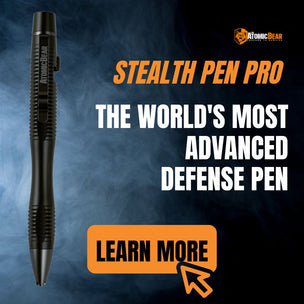
Why Tactical Pens Work in the UK
A tactical pen occupies a unique legal position. It's a functional writing instrument—not designed or marketed as a weapon. Under UK law, everyday objects can be used defensively in a genuine emergency under Section 3 of the Criminal Law Act, provided the response is reasonable and proportionate.
"The best self-defence tool is one that doesn't look like a weapon, doesn't require permits, and can't create legal problems just by existing in your pocket. A pen meets all three criteria." — Jean-François Truchon, Covert Self-Defense
| Factor | Pepper Spray | Tactical Pen |
|---|---|---|
| Legal in UK? | No—prohibited firearm | Yes—writing instrument |
| Classified as Weapon? | Yes—Section 5 firearm | No—it's a pen |
| Can Purchase? | No | Yes—anywhere |
| Can Carry Daily? | No—criminal offense | Yes—normal pen |
| Border Issues? | Seized + arrest | No issues |
| Use in Emergency? | Criminal offense | Covered under Section 3* |
| Everyday Function? | None | Functional pen |
| Expires? | 2-4 years | Never |
*As with any defensive action in the UK, the use must be reasonable and proportionate to the threat under Section 3 of the Criminal Law Act 1967.
Want to learn proper deployment techniques that align with UK self-defence law? Our training partner Doug Marcaida, renowned blade expert from the TV series Forged in Fire, developed The Way of The Pen curriculum specifically for tactical pen defence.

Frequently Asked Questions
Is pepper spray legal in the UK for self-defence?
No. Pepper spray is classified as a Section 5 prohibited firearm under the Firearms Act 1968. It is illegal to possess, carry, buy, or use pepper spray in the UK under any circumstances, including self-defence. Penalties can include up to 10 years in prison.
Can I bring pepper spray into the UK from another country?
No. Importing pepper spray is illegal. Border Force screens for prohibited weapons, and pepper spray will be seized. You may be arrested and face criminal charges for importing a prohibited firearm, even if the spray was legal in your home country.
Can I buy pepper spray online and have it delivered to the UK?
No. Online orders of pepper spray to UK addresses are illegal. Customs screens international packages, and prohibited items are seized. You could face prosecution for attempting to import a prohibited weapon.
What's the penalty for carrying pepper spray in the UK?
Possession of pepper spray is a criminal offense punishable by up to 10 years in prison if tried in Crown Court, or up to 6 months in Magistrates' Court. You will also receive a permanent criminal record.
Why is pepper spray classified as a firearm in the UK?
The Firearms Act 1968 defines "firearm" broadly to include any weapon that discharges a noxious substance. Because pepper spray releases an incapacitating chemical (oleoresin capsicum), it meets this definition. The classification reflects the UK's strict approach to weapons control.
Are there any legal self-defence sprays in the UK?
Yes, but not incapacitating ones. "Criminal identifier" sprays like Farbgel are legal because they contain no noxious substances—only a red dye that marks attackers for police identification. They can startle and temporarily obscure vision but don't cause pain or injury like pepper spray.
What can I legally carry for self-defence in the UK?
The UK does not permit carrying weapons for self-defence. However, legal alternatives include personal alarms, criminal identifier sprays (Farbgel), tactical flashlights, and safety apps. In an emergency, you may use everyday objects (keys, umbrella, pen) defensively if your response is reasonable and proportionate.
Are tactical pens legal in the UK?
Yes. A tactical pen is a functional writing instrument and is not classified as a weapon. You can purchase, carry, and travel with one without legal issues. If used defensively in a genuine emergency, the response must still be reasonable and proportionate under Section 3 of the Criminal Law Act 1967.
The Bottom Line
Is pepper spray legal in the UK? No—and the prohibition is absolute. The UK classifies pepper spray as a Section 5 prohibited firearm, placing it in the same category as handguns and automatic weapons. There is no permit system, no exception for self-defence, and no way for civilians to legally possess it. Penalties can reach 10 years imprisonment.
For UK residents who want effective personal safety within the law, the answer isn't a prohibited weapon—it's awareness, training, and tools that don't create legal risk. A tactical pen offers the perfect balance: a functional everyday object that can serve a defensive purpose in a genuine emergency, all while staying completely within UK law.
Disclaimer: This article is for informational purposes only and does not constitute legal advice. UK law is complex, and enforcement can vary by circumstance. Always consult with a qualified UK solicitor for advice specific to your situation.