Free ground shipping on order above $150 (USA)
 MEMBERS LOGIN



 Photograph JF Truchon
Beneath the rule of men entirely great, the pen is mightier than the sword.
— Edward Bulwer-Lytton
I remember that day when I was sitting on a plane with my wife and my four-month-old daughter. We were 30,000 feet above the Pacific Ocean and this guy wanted to hurt our daughter. How effectively can I push back against a crazy person without a weapon? This was back in 2005, three years after Jason Bourne had used a Bic pen in the Bourne Identity.
Back home, I took a Bic pen and tried to "Jason-Bourne" a soccer ball. That pen broke, I hurt my hand. And the ink stained everything around.
People, including me, have taken on the task of creating pens that could actually be useful in that regard and yes, add that additional layer of protection.
I became obsessed with combat pens. I wrote a 364-page book about the subject. Worked with the best martial artists like Doug Marcaida and Natan Levy, just to name a few. I integrated my pen designs in reality-TV shows centered on realistic self-defense scenarios like knife attacks vs. pen (this show is called the Ultimate Self-Defense Championship, or USDC).
In this post, I will try to share EVERYTHING with as much depth as possible. To get more, get my book! I said that I designed tactical pens... yes, I am currently at six models. You can find them in our tactical pens collection. I love this stuff!
Let's start answering your questions, your friends' questions, and probably questions that you never thought existed!
Key Takeaways
- Writing Tool First: A tactical pen is a fully functional pen built from materials strong enough to withstand repeated strikes without breaking — it writes, and it fights.
- Force Multiplier: The pen concentrates striking force onto a small point, turning an ordinary grip into a serious close-quarters defensive tool, validated in USDC Season 2 testing.
- Legal Nearly Everywhere: Tactical pens are legal to carry in most jurisdictions because they are writing instruments first — a critical advantage over knives, pepper spray, and kubatons.
- Material Matters: Aircraft-grade aluminum (6061-T6 or 7075-T6), titanium, and weapons-grade polymer each serve different carry profiles and budgets.
- Training Elevates the Tool: A tactical pen without training is still better than bare hands — but a tactical pen with training, as shown by Doug Marcaida and the USDC competitors, is a serious defensive system.
- Discretion Is the Feature: The best tactical pen is one that looks like a pen, passes through security without a second look, and sits in your pocket until the moment it matters.
What Exactly Is a Tactical Pen?
🔍
A tactical pen is a writing instrument engineered to survive repeated full-force impacts — and to concentrate striking force onto a point smaller than a pencil eraser. It writes first. It fights second.
The word "tactical" is overused and too often applied to gimmick objects. In the case of a pen, I like to think of synonyms like combat pen or self-defense pen.
Because, first, it needs to be a pen. Ideally, tough enough to resist high-impact strikes and pointy enough to concentrate force and inflict enough pain to stop or slow down an assailant. By construction, a tactical pen is a close-quarters self-defense device.
Where a standard ballpoint uses thin plastic or cheap metal, a tactical pen uses aircraft-grade aluminum, stainless steel, titanium, or weapons-grade polymer.
The body is thicker. The weight is deliberate. The grip is textured for retention under stress. And the whole thing is engineered to survive repeated full-force impacts against hard surfaces without cracking, bending, or losing its ability to write.

Here is a simple test I use. Take the pen and strike it at full force into a wooden post or a body opponent bag. Do it ten times. Then uncap it and write your name. If the pen still works and your hand is not in pain, you are holding a tactical pen. A standard plastic pen fails this test on the first strike.
The pen functions as what martial artists call a force multiplier. Your fist alone distributes force across a wide surface. A pen concentrates that same force onto a point smaller than a pencil eraser.
The multiplication factor is roughly the surface area of your closed fist divided by the cross-section of the pen tip. In practical terms, that means a strike delivered with a pen to a sensitive area like the throat, temple, or solar plexus carries significantly more impact per square millimeter than a bare-knuckle punch.
I wrote about this concept in detail in my book Covert Self-Defense (2025). I agree with the picture that even a four-year-old child striking with a pen will make a grown adult flinch and pull away.
The key insight: even a four-year-old child striking with a pen will make a grown adult flinch and pull away. That is the force multiplier at work.
What a Tactical Pen Is NOT
A tactical pen is not a knife disguised as a pen. Some hybrid models on the market conceal blades inside the barrel, but those occupy an entirely different legal category, and I recommend against them for everyday carry. Why? It will be a tiny knife, and a concealed knife is illegal in many more jurisdictions.
It is not a firearm. It is not a toy. And it is not a guaranteed self-defense solution. A tactical pen without any training is still better than bare hands. But the pen on its own does not make you prepared. Training does. We will cover that distinction throughout this article.
The skeptics show up in every Reddit thread and YouTube comment section. "Just use the right tool for the job," they say, or "it's just a marketing gimmick."
I understand the skepticism. The market is flooded with $12 aluminum tubes that write poorly and break on the second strike. Those pens deserve the criticism. A properly built tactical pen, carried daily and trained with, is a different category entirely.
Also read: Why Tactical Pens Are Safer Than Knives for Self-Defense
Tactical Pen vs. Regular Pen: The Difference
| Feature | Tactical Pen | Regular Pen |
|---|---|---|
| Body material | Aircraft aluminum, titanium, steel, or weapons-grade polymer | Plastic or thin metal |
| Weight | 1–3 oz (deliberate for strike mass) | Under 0.5 oz |
| Survives full-force impact | Yes — designed for it | Can crack or shatter |
| Grip texture | Knurled, scalloped, or grooved for retention | Smooth |
| Glass breaker | Often included (tungsten carbide tip) | No |
| Writing quality | Varies by model — premium models write excellently | Generally smooth |
| Self-defense capability | High (with training) | Minimal |
| Price range | $10–$200+ | $1–$500+ |
History of the Tactical Pen
The concept of fighting with a small portable object that fits in one hand and does not have a blade is not new. Let's quickly go over the predecessors of the tactical pen.
The Kubotan: Where It Started
In the late 1960s, Soke Takayuki Kubota created the Kubotan, a hard plastic rod about 5.5 inches long with six machined grooves and a keyring attachment. The name was a combination of "Kubota" and "baton." Kubota based the design on his father Denjiro's "hashi stick," a small bamboo striking weapon from traditional Japanese martial arts.

The kubotan's real-world debut came when California State Senator Edward M. Davis, formerly the chief of the LAPD, asked Kubota to develop a less-lethal tool for female police officers. Kubota trained LAPD officers in pressure-point control and close-quarters restraint using the device. It worked. The kubotan spread through law enforcement agencies across the country.
The kubotan shares its DNA with older weapons: the yawara stick from Japanese jujutsu, the dulo-dulo from Filipino Martial Arts, and the koppo stick carried by Buddhist monks.
All of them follow the same principle — a short, hard rod held in the fist to concentrate force and control pressure points. The tactical pen is a direct descendant of all of these. For a deeper look at kubotan history and technique, read 12 Frequently Asked Questions About Kubatons Answered.
How the First Tactical Pen Was Born
Around 2005, knife maker Rick Hinderer had been producing kubatons and training in martial arts when he noticed something. A kubaton with a pointed end looked a lot like a pen tip. He built a "Modular Kubaton" with threaded ends that could accept interchangeable strike tips or a pen cartridge module. The concept worked.
American Cop Magazine featured Hinderer's design with field reports from law enforcement officers who carried it daily ("Getting the Point Across: The Hinderer Pen” by Paul Markel, May/June 2007).
Hinderer followed up with the Extreme Duty Pen, built entirely from titanium and aerospace-grade materials. It was the first product marketed specifically as a tactical pen rather than a kubaton with a writing function. The category was born.
From Niche to Mainstream
The Bourne Identity (2002) changed public perception overnight. The pen fight scene — Jason Bourne fending off a trained assassin with a ballpoint — made millions of viewers think about pens as defensive tools. It is no accident that consumer interest in tactical pens spiked in the years following that film. I referenced this scene in Covert Self-Defense because it marks the moment pens entered the self-defense conversation for ordinary people.
The EDC (everyday carry) movement, which exploded online between 2010 and 2015, gave tactical pens a permanent home. Collectors and preparedness-minded professionals began curating daily carry kits that included a knife, a flashlight, and a pen. Brands responded.
Gerber built the Impromptu with law enforcement input. CRKT partnered with James Williams, a former Army officer and martial arts instructor, to design the Williams Tactical Pen. Smith & Wesson entered the market. And I built The Atomic Bear.
In 2023, the luxury pen market in the United States was valued at $312 million and was projected to reach $340 million by 2029. Tactical pens now occupy a growing segment of that market, with clear price tiers from budget ($10–$25) to ultra-premium titanium models above $150.
What Is a Tactical Pen Made Of?
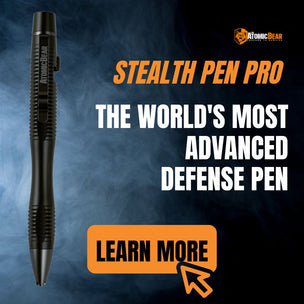
This question makes me smile. Until I created the Stealth Pen Pro, all tactical pens were made of metal. I wanted to create a lightweight and slightly larger pen for a better fighting grip. So I used a high-tech polymer for the largest components. There is no rule!
As long as it is tough as nails, looks and feels good, in my book it is good! Let's examine what the industry is currently making.
Aircraft-Grade Aluminum: 6061 vs. 7075
"Aircraft-grade" is not marketing language. It refers to specific alloy designations used in aerospace manufacturing. The two most common in tactical pens are 6061-T6 and 7075-T6.
The "T6" suffix matters. It indicates the metal underwent a specific heat treatment process that increases hardness and tensile strength. Without T6 treatment, the same aluminum alloy would be significantly weaker.
6061-T6 is the general-purpose option. Good strength, excellent corrosion resistance, easy to machine. Most mid-range tactical pens use it. 7075-T6 contains zinc, making it substantially harder and closer to soft steel in tensile strength.
It costs more to produce and appears in premium models. When a product listing says "aircraft aluminum" without specifying the alloy, it is almost always 6061.
Aluminum pens are the most common on the market because they balance durability, weight, and manufacturing cost. They are strong enough for defensive use and light enough for daily carry.
Titanium: The Premium Choice
Titanium has the highest strength-to-weight ratio of any tactical pen material. It will not corrode, will not bend under impacts that would dent aluminum, and will not fatigue over decades of daily use.
The tradeoff is price. Titanium tactical pens cost three to five times more than aluminum equivalents.
For the Guardian Titanium, we use Grade 5 titanium (Ti-6Al-4V) — the same alloy used in aircraft engine components and surgical implants to ensure it survives any environment.
Who actually needs titanium? If you want a tool that will outlast you, titanium is the right choice. If you carry your pen every day, write with it regularly, it's worth the investment.
Stainless Steel, Brass, and Polymer
Stainless steel is heavier than both aluminum (3x) and titanium (nearly 2x). That weight gives it a substantial feel and adds mass behind strikes, but it makes daily carry in a shirt pocket impractical. The Gerber Impromptu used machined stainless steel and earned a loyal following among law enforcement officers who valued the heft.
Brass is a niche material. It develops a patina over time and appeals to collectors who want a pen that ages visually. Not common in the tactical segment.
Weapons-grade polymer is the exception that breaks the rules. When I designed the Stealth Pen Pro, I chose a hard polymer specifically because it makes this pen the one of the lightest tactical pen on the market while remaining large and durable enough to survive repeated strikes.
Some people have suggested that polymer looks and feels like an ordinary pen on X-ray machines. That discretion is the entire point.

Glass Breaker Tips: Tungsten Carbide
Not all tactical pens include a glass breaker, but the feature has become standard on most mid-range and premium models. The material is tungsten carbide, which sits at 9 to 9.5 on the Mohs hardness scale. Tempered automotive glass sits at 5.5 to 6.5.
The math is simple: a sharp, hard point concentrates force into a stress fracture that causes the entire panel to shatter. The six models that we make at Atomic Bear all have a glass breaker. The reason is simple: this is a lifesaving feature!
The technique matters as much as the material. Strike the corner of a car window, not the center. Corners are the weakest point in tempered glass. One quick, forceful strike is more effective than multiple weak ones.
The glass breaker works on side and rear windows (tempered glass) but not reliably on windshields, which use laminated glass with a plastic interlayer.
When using a glass breaker in an emergency, aim for the bottom corner of the window and strike with one decisive motion. Do not push slowly — the tip needs impact velocity to create the stress fracture.
Ink Cartridge Types
A tactical pen that writes poorly is just a kubotan with pretensions. Writing quality depends on the ink cartridge, the pen balance, and the overall pen dimensions.
Here are some of the best tactical ink refills in the market:
The Fisher Space Pen refill is the gold standard for extreme conditions. It uses a pressurized ink cartridge that writes upside down, underwater, in temperatures from -30°F to 250°F, and in zero gravity. The writing experience is slightly harder than a standard ballpoint because of the pressurized formula, but reliability is unmatched.
The Schmidt EasyFLOW 9000 offers the smoothest writing experience of any tactical pen refill. If writing quality is your priority, look for pens compatible with this cartridge. The Schmidt P900 is a reliable mid-tier option.
Most tactical pens accept Parker G2-style refills, which are the most widely available and least expensive to replace. If you buy a pen that uses a proprietary cartridge you cannot find at an office supply store, you will eventually stop carrying it. Compatibility matters.
Key Features to Look For in a Tactical Pen
I have tested hundreds of pens in striking and simulated combat. When you strike a hard surface, you quickly realize if a pen is fit for combat. Does it come out of your hand? Does it hurt your hand? Does it break?
Grip Design: Why It Matters More Than You Think
When teaching how to strike in seminars, students are always surprised how much it hurts their hand when they apply some force. I developed my curriculum with Doug Marcaida, Filipino Martial Arts expert, and we determined that we can hold a pen in only three ways when fighting. The level of retention is determined by multiple factors.
Grip patterns fall into three categories: knurling (cross-hatched machining), scalloped surfaces (curved indentations), and CNC-machined finger grooves. Each affects both writing comfort and weapon retention differently.
The test is simple: wet your hands, grip the pen, and strike a bag ten times at full force. If the pen moves in your hand or causes pain, the grip has failed. I covered this testing process extensively in Covert Self-Defense, where in Chapter 10 with Doug Marcaida, we show our findings about grips and striking techniques.
This experience led me to modify the shape of the pens I design — creating a narrow section on the shaft that acts as a natural guard and prevents your hand from sliding forward during a thrust. The diameter of the shaft itself determines how securely your fingers wrap. Too slim, and the pen rolls under pressure. Too thick, and you lose fine motor control for writing. The ideal is a slight taper at the grip point with texture that catches skin without abrading it.
Lastly, the ideal tactical pen has a flat end on its top. Not a clicker. A flat surface. This allows us to stabilize the three grips (overhand, underhand, and modified overhand).
Clip and Carry
The clip serves two functions: pocket retention and rapid deployment. A weak clip that bends after a week in your jeans pocket means you will stop carrying the pen. A strong clip — 304 stainless steel or better — holds the pen firmly whether it is clipped to a waistband, a shirt collar, a jacket interior, or a bag strap.
Deep-carry clips allow the pen to sit low in the pocket for concealment. This matters for discretion-focused carriers who want the pen accessible but invisible. For a detailed look at every carry option, from waistband to magnetic mount, read 13 Ways To Carry Your EDC Pen for Self-Defense.
Writing Performance
If the pen does not write well, you will not carry it. If you do not carry it, it cannot protect you. This is the equation most tactical pen buyers overlook.
Premium models using Schmidt EasyFLOW 9000 or Fisher Space Pen refills write as smoothly as dedicated executive pens. Budget models using generic refills often scratch, skip, or dry out.
Before committing to a pen, check what refill it accepts and whether replacements are readily available.
What to May Want to Reconsider
Hidden blades turn a writing instrument into a concealed weapon under many state laws—worth checking your local laws. They are also often non-ideal writing instruments, they may be heavier than necessary, which means that you won't carry them over time, and they are usually not the best blades.
So they are a sum of compromises, for the ability of carrying a small concealed blade. It is a trade-off that some are ready to make.
How Is a Tactical Pen Used for Self-Defense?
Let's look into the relatively new "science" of fighting with a pen. There are many ways to fail in using a pen against an aggressive assailant. But there are a few good ways to deter and possibly neutralize a threat.
The Three Core Grips
In Covert Self-Defense, I detailed three specific grips optimized for pen fighting, developed through training with Doug Marcaida.
The underhand grip positions the pen tip below the hand, with the thumb acting as a stopper to prevent the hand from sliding backward on impact. This grip provides control, stability, and power for striking sensitive targets. Because pens lack the guard feature found on fighting knives, the thumb stop is critical.

The overhand grip (palm-stop) is a thrusting grip. The butt end of the pen presses against the palm, preventing forward slippage during a thrust. This grip gives you the greatest reach and is the preferred grip for fencing-style counters, as demonstrated by the USDC Season 2 competitors.
The modified overhand grip positions the pen against the pinky for slashing, scraping, and pulling motions. This grip targets soft tissue and clothing, aiming to deter an attacker without maximum force.
In all three grips, focus on applying pressure with every finger in contact with the pen at the moment of impact. A loose grip wastes force and risks losing the pen to your attacker.
Does a Tactical Pen Actually Work? The USDC Test
I firmly believe that the use of the pen is a uniquely powerful solution to self-protection, and the Ultimate Self-Defense Championship (USDC) Season 2 and Season 3 proved it under conditions that are as realistic as a safe confrontation with padding and masks allows.
Six contestants used a trainer version of the Stealth Pen Pro across a week of realistic, variable self-defense scenarios: bus attacks, bar confrontations, cage fights, and multi-attacker situations. The Stealth Pen Pro fits a practice head that transforms this pen into a safer tool when practicing.
In the USDC contest, the pen gave contestants a measurable advantage over bare hands across multiple scenarios, with more reach, more options, and often faster resolution. Deployment speed proved decisive. Competitors who had their pen clipped and accessible (Jesse Enkamp, Natan Levy, UFC fighter and Stealth Pen Pro advocate) responded effectively. Those who fumbled deployment paid for it immediately.
The USDC is not a laboratory. It is the closest thing we have to real-world self-defense testing with a pen, and the results were clear: a tactical pen, properly trained with and properly deployed, is a serious defensive tool. Not a toy. Not a gimmick.
For a detailed breakdown of Natan Levy's techniques and his endorsement, read Natan Levy Reveals His Self-Defense Pen Secret – The Stealth Pen Pro.
The Martial Arts Connection
Tactical pen technique draws primarily from Filipino Martial Arts (FMA), also known as Escrima, Arnis, or Kali. The stick-fighting traditions of FMA translate directly to short impact weapons. The Equis (X Pattern) defense, demonstrated by Nik Farooqui of the Xtreme Training Academy in the most-viewed tactical pen YouTube video (734,000+ views), originates in FMA.
Krav Maga integrates improvised weapon training, including pens, as part of its close-quarters combat curriculum. Nick Drossos, a defensive tactics instructor, teaches tactical pen courses that emphasize mental conditioning as much as physical technique.
I trained with Doug Marcaida, Travis Roesler, and Mike Pesesko. Each brought a different lens to the pen. Marcaida brought Filipino weapon flow. Roesler brought fencing footwork and distance control. Pesesko brought clinch work and chained strikes. The pen adapts to all of these systems because the principles are universal: distance management, grip retention, proportional force.
My personal expertise is fencing. I used to compete at a national level in my 20s. In Chapter 11 of Covert Self-Defense, I show the reader specifically how one can use Olympic fencing techniques to deploy powerful and unexpected counter-offensive strikes.
For readers interested in which martial arts best complement pen training, I recommend Best Martial Arts for Self-Defense: Expert Rankings and Tier List.

"A decisive strike should be deliverable without losing control of the pen or causing harm to yourself."
Are Tactical Pens Legal?
The short answer is yes, tactical pens are legal to carry in most jurisdictions worldwide because they are, first and foremost, writing instruments. There are caveats on the purpose of carry in countries like Canada, the UK, or Australia.
I like to think that if I write and drive, carrying a functional pen with a car window glass breaker is enough to justify a main non-defensive reason to carry. For a deep dive on TSA-specific rules, read Tactical Pen and Airport Security: Is it Legal?
I need to make something clear here. I am not an attorney. Please consider what follows as education, not legal advice. Consult a qualified attorney in your jurisdiction for specific guidance.
The Legal Advantage
A tactical pen occupies a unique position in the legal spectrum of self-defense tools.. Unlike a knife, which is explicitly regulated in most states and banned outright in some buildings, a pen is an everyday object with an obvious non-weapon purpose.
Unlike pepper spray, which is restricted by size, concentration, and carrier age in states like New York and New Jersey, a pen has no purchase restrictions anywhere.
The legal optics of defending yourself with a pen differ significantly from defending yourself with a knife or firearm. As Attorney Andrew Branca, author of The Law of Self Defense, says the tool you use in self-defense affects how a jury perceives your intent and proportionality.
A pen reads as an everyday object repurposed under duress. A combat knife reads as premeditation.

Two court cases illustrate the ambiguity. In 2004, a California court deemed a sharp pencil used in a robbery to be a deadly weapon. In Massachusetts, a court declined to classify a pen used in a confrontation as a deadly weapon. These are the only cases I could find involving a pen or pencil as a weapon, and they reached opposite conclusions.
In People v. Page, 123 Cal. App. 4th 1466 (2004), a California court ruled that a sharp pencil used during a robbery qualified as a deadly weapon.
In Commonwealth v. Rezendes, 88 Mass. App. Ct. 369 (2015), a Massachusetts court declined to classify a pen as a deadly weapon — reaching the opposite conclusion.
U.S. State Considerations
Carrying a tactical pen is unrestricted in all 50 states in the United States for ordinary civilian carry.
As of writing this article, carrying a tactical pen is not specifically restricted by any state statute in the United States for ordinary civilian carry—local ordinances and venue-specific rules may apply.
Potential friction points are limited to specific locations: government buildings with security screening, courthouses, schools (administrator discretion applies), and secure facilities.
The more a pen looks like it belongs to a SWAT police officer, the less likely it is to be accepted everywhere. More on this below.
The Canadian Legal Paradox
Since The Atomic Bear is a Canadian company, I want to address something most tactical pen articles never mention. In Canada, owning and carrying a tactical pen is legal.
However, section 88 of the Canadian Criminal Code makes it an offense to carry any object 'for a purpose dangerous to the public peace.' Courts have interpreted this to include carrying objects specifically for self-defense.
This creates a paradox. The pen itself is legal. Carrying it because you like writing with it is legal. Carrying it specifically to defend yourself is, technically, not. The legal distinction rests entirely on stated intent, not on the object. This is why I always say: the primary reason to carry any pen is to write. It is a writing instrument that happens to be built tough enough for other uses.
International Legality
Tactical pens are generally legal as writing instruments in the UK, EU, and Australia. Intent and context determine whether carrying one becomes a legal issue. Standard tactical pen models generally do not require special customs declarations in most Western countries, though regulations vary by destination.
Self-defense laws — duty to retreat, proportional force, stand your ground — still apply regardless of which tool you use. A pen does not exempt you from legal responsibility. Understand the self-defense laws in your jurisdiction before carrying any defensive tool. We are not providing authoritative legal advice and I am not an attorney! Check all the legal information with your local authorities.
For a deep dive on TSA-specific rules, read Tactical Pen and Airport Security: Is it Legal? TSA Approved?.
Tactical Pens and Air Travel (TSA)
Can we bring a "tactical" pen on a plane? Our support team and I have been asked this question countless times. The answer requires more nuance than most forum posts give it.
There is no such thing as "TSA approved" for tactical pens. That designation does not exist. The TSA website does not maintain a blanket approved or prohibited list for tactical pens. The final decision on whether your pen passes through a security checkpoint rests with the individual TSA officer screening your bag. Their website says that a 'tactical' pen is not allowed on the plane with you.
Checked luggage is always permitted. No restrictions, no questions. If your pen is valuable and you cannot afford to lose it, pack it in checked baggage.
For carry-on, the variables are: how tactical does your pen look? A pen with aggressive crenulated bezels, a prominent glass breaker spike, or a Smith & Wesson logo on the clip is more likely to draw scrutiny. A pen that looks like a pen — polymer body, no visible "weapon" features, standard clip — passes through without comment the vast majority of the time.
I have personally gone through TSA and international security checkpoints over 100 times across 15 countries with the Stealth Pen Pro. It has never been removed. Not to say it is not a possibility. With the Stealth Pen Pro and the Guardian, one can temporarily remove the glass breaker. It is probably a wise decision. Several customers reported the same experience with some of our models. Our SWAT pen is less likely to be allowed.
This is not a guarantee. It is a data point from extensive personal experience.
Tactical Pen vs. Kubaton: What Is the Difference?
If you have been reading this far, the answer might seem obvious on the surface, but there are important distinctions.
A kubaton is a dedicated self-defense tool. It has no secondary function. It does not write, does not break glass, does not clip to a shirt pocket. It is a hard rod designed to concentrate force and apply pressure-point control, often with a keyring attachment for carry.
A tactical pen does everything a kubaton does plus writes, plus often includes a glass breaker, plus is far more discreet. A kubaton in your pocket looks like a weapon to anyone who sees it. A pen in your pocket looks like a pen.
The legal distinction matters. In some jurisdictions, kubatons are classified alongside weapons and restricted accordingly. Pens are not. At TSA checkpoints, a kubaton will be confiscated. A pen that looks like a pen often passes through.
For buyers deciding between the two: if you want a dedicated defensive tool for environments where appearance does not matter, a kubaton works. If you want a tool that lives in your pocket every day, writes when you need it, passes through security, and provides defensive capability when everything else fails, a tactical pen is the better choice.
For more on kubatons, read 12 Frequently Asked Questions About Kubatons Answered.
Who Carries a Tactical Pen?
Our customers! OK, that is a cheesy answer. Who are The Atomic Bear customers? I'll share proprietary data here.
Everyday Carry Enthusiasts
The EDC community treats tactical pens as a standard kit component alongside knives, flashlights, and watches. These buyers care about materials, machining quality, bolt-action mechanisms, and writing performance. They own multiple pens and rotate them based on the day's needs.
Travelers and Commuters
People who move through unfamiliar cities, airports, parking garages, and public transit want a defensive option that is portable, legal, and discreet. A tactical pen meets all three criteria in ways that a knife or pepper spray cannot.
Workers in Restricted Environments
Teachers, nurses, healthcare workers, security officers, and detention facility staff cannot carry firearms or knives to work. A pen, however, is standard equipment. One review on our store put it directly: "I teach school, therefore can't carry a concealed handgun at work, but I CAN carry a pen."
Parents Buying for Young Adults
College safety is a recurring purchase driver. Parents buy tactical pens for sons and daughters heading to campus as a discreet personal safety gift. We addressed campus safety strategies in Essential 8 Tips on College Safety.
Military, Law Enforcement, and First Responders
Professional users value durability, glass-breaking capability, and weapon retention in field conditions. One reviewer, Keith, a 55-year-old martial artist who has carried tactical pens for 12 years, wrote that he "turned most of our martial arts schools onto the Stealth Pen Pro."
"I carry 2 tac pens... The Stealth Pen Pro will do the job in a self-defense situation in a less lethal way, and hopefully save on legal fees... I'm 55 years old and trained in martial arts... I've had several tac pens in my collection over the years, and I kept the stealth pen pro."
Trained under Marcaida. Tested in USDC. Carried through 100+ TSA checkpoints.
Tactical Pen vs. Other Self-Defense Tools
People often tell me, "I carry a knife, why should I bother carrying a tactical pen?" The answer comes down to five factors that all point in the same direction.
| Feature | Tactical Pen | Kubaton | Pocket Knife | Pepper Spray |
|---|---|---|---|---|
| Legal to carry (general) | Yes — nearly everywhere | Varies by state | Varies by state | Varies by state |
| TSA carry-on | Depends on the pen, officer discretion | No | No | No |
| Self-defense effectiveness | High (with training) | High | Very high | High (ranged) |
| Discretion | Very high | Medium | Low | Low |
| Writing function | Yes | No | No | No |
| Glass breaking | Yes (tungsten tip) | No | Maybe | No |
| Legal risk if used |
Lower but varies by jurisdiction and circumstances |
Medium | High | Medium |
| Price range | $10–$200 | $5–$30 | $20–$300 | $10–$30 |
The tactical pen wins on the combination of legality, discretion, and multi-function capability. A knife is more effective as a weapon, but it carries dramatically higher legal risk when used and is restricted in many environments.
Pepper spray is more effective at a distance, and is under multiple restrictions, or ban, based on your jurisdiction. It cannot pass through any security checkpoint, and risks exposing you or bystanders to its effects.
It is also less reliable in close proximity — where most assaults begin — and risks exposing you or bystanders to its effects.

I wrote extensively about the pen versus knife question in Covert Self-Defense, and my colleague Chelsea Kyann, a professional MMA fighter, made the case clearly: for most people in most situations, a pen offers a better balance of accessibility, legality, and defensive capability than a blade. For more on this argument, read Trade Your Knife for a Pen For Self-Defense ASAP? and Knife Self-Defense is Not For Everyone.
How to Choose Your First Tactical Pen
Because I am into defensive pens, I own nearly 100 of them. And I will switch depending on where I am going that day, or... how I feel! If you are looking to get your first tactical pen, let me help you find the main decision factor for you.
Define Your Primary Use Case
If self-defense is the priority: focus on grip retention, material durability, and a design that supports training with a partner or body opponent bag. Check whether the manufacturer offers a training version of the same pen so you can practice with realistic weight and dimensions. The Stealth Pen Pro was designed specifically for this — the same pen you carry daily can be converted into a training tool.
If daily writing is the priority: check the ink cartridge type, the weight and balance, and whether the deployment mechanism (bolt action, twist, or click) feels natural for one-handed use. If you want a deeper breakdown of how the bolt-action mechanism works and why it matters, also read What Is a Bolt Action Pen?"
If travel is the priority: discretion overrides everything. Choose a pen that looks like a pen. Maybe a polymer body. No aggressive styling. No glass breaker tip visible from the outside. No brand logo that signals "tactical."
Set Your Budget
At the budget tier ($10–$25), expect aluminum construction, basic grip texturing, and generic ink cartridges. Pens in this range like the Atomic Bear SWAT and Rebel are functional but will not match the writing quality or build refinement of higher tiers.
At mid-range ($25–$75), you get better alloys, machined grips, and improved ink cartridge compatibility. The CRKT Williams Tactical Pen, the Stealth Pen Pro, and Gerber Impromptu live here.
At the premium tier ($75–$200+), titanium becomes available. The Guardian Titanium and Hinderer Extreme Duty Pen offer materials and construction that last decades. These are lifetime purchases, not impulse buys.
Check Refill Compatibility
If the pen uses proprietary cartridges that you can only buy from one source, you will eventually run out and stop carrying the pen. Parker G2-compatible refills are the safest bet — available at any office supply store. Fisher Space Pen refills are the best for all-conditions reliability. Check compatibility before you buy.
For a tested comparison of ten tactical pens across writing quality, grip, glass breaking, and self-defense capability, read Best Tactical Pen 2026: Our Top 10 Tested and Compared.
The Pen in Your Pocket
Getting back to the initial question: "What is a tactical pen?" I think that you know a lot more now. The more we dig into this subject, the more we discover!
The answer turned out to be larger than a definition. A tactical pen is a writing instrument built to survive impact. It is a force multiplier grounded in martial arts traditions older than most countries. It is one of the only defensive tools that is legal to carry virtually everywhere, discreet enough to pass through security, and functional enough to sign the dinner check.
But purchasing your first pen is just the beginning. Training is what turns a piece of aluminum or titanium or polymer into a real defensive system. The grips, the deployment, the distance management, the decision-making under pressure. Those are the skills that matter. The pen makes those skills more effective. It does not replace them. We teach how to use a pen in self-defense in my book Covert Self-Defense, and in our course with Doug Marcaida as the teacher, "The Way of the Pen."
If you walked into this article curious, I hope you leave knowing exactly what a tactical pen is, what it is made of, what it can and cannot do, and whether it belongs in your pocket. If it does, the next step is straightforward: pick one, carry it, train with it, and write with it every day.
Key Takeaways
- Definition: A tactical pen is a writing instrument built from high-strength materials to function as both a daily pen and a close-quarters self-defense device.
- History: The lineage runs from the Japanese yawara stick through Takayuki Kubota's LAPD kubaton to Rick Hinderer's first dedicated tactical pen in 2005.
- Material: 6061-T6 and 7075-T6 aluminum for most users; titanium for lifetime carry; weapons-grade polymer for maximum discretion and TSA confidence.
- Effectiveness: Validated in USDC Season 2 testing with six competitors across realistic scenarios — the pen provided a measurable advantage over bare hands.
- Legality: Legal to carry in most jurisdictions worldwide as a writing instrument; self-defense laws still apply to its use.
- Training Required: A pen without training is better than nothing — a pen with training is a complete defensive system.
"I didn't want a device that looked like a pen, I wanted a pen that could do these other amazing things. In addition to being a martial artist and former bodyguard, I'm a geek who tends to need to write things down. Imagine my surprise when I found both in one tool."
Designed by a pen fighter. Tested in competition. Carried worldwide.
Frequently Asked Questions
Is a tactical pen legal? ▾
Yes, tactical pens are legal to carry in most jurisdictions worldwide because they are classified as writing instruments, not weapons. Unlike switchblades, brass knuckles, or pepper spray, pens face no carry restrictions in most U.S. states. However, using any object as a weapon in a confrontation carries legal consequences under self-defense law. Check local regulations, as we are not providing legal advice.
Are tactical pens allowed through TSA? ▾
Tactical pens are officially not allowed in your carry-on luggage. However, it is up to the TSA officer to make the decision about every object you carry. Pens that look like ordinary writing instruments pass through more easily than those with aggressive tactical styling or visible glass breaker tips. Checked luggage is always permitted.
Can you take a tactical pen to school? ▾
Tactical pens are not prohibited by weapon laws for minors or adults because they appear to be ordinary pens. However, school administrators may confiscate them at their discretion if the pen is identified as a tactical product. A discreet design matters here.
Is a tactical pen better than a regular pen? ▾
For writing alone, a quality ballpoint may write equally well. The difference is durability and secondary capability. A tactical pen can survive full-force impacts that shatter a regular pen, break car windows in emergencies, and provide close-quarters defensive capability when needed. A regular pen cannot.
Do tactical pens really work for self-defense? ▾
Yes, with caveats. The USDC Season 2 testing demonstrated that trained users with a tactical pen had a measurable advantage over bare hands across realistic scenarios. Training matters more than the tool. A tactical pen without training is still better than nothing, but training is what turns the tool into a system.
Can a tactical pen break car glass? ▾
Yes, pens with tungsten carbide glass breaker tips can shatter tempered automotive glass (side and rear windows). Strike the corner of the window with one decisive motion. The tip does not reliably break laminated windshield glass, which has a plastic interlayer.
What is the difference between a tactical pen and a kubotan? ▾
A kubotan is a dedicated self-defense tool with no writing function. A tactical pen writes, breaks glass, clips discreetly, and provides the same strike capability. Kubotans are restricted in some jurisdictions and at all TSA checkpoints. Tactical pens face fewer legal restrictions because of their primary function as writing instruments.
Do you need training to use a tactical pen? ▾
Training is recommended but not required. Basic grip and target zone knowledge significantly increases effectiveness. Filipino Martial Arts (FMA), Krav Maga, and reality-based self-defense systems all teach pen-applicable techniques. The book Covert Self-Defense (2025) covers three core grips, deployment, and a full progression of techniques in Chapters 10 and 11.
What ink refills do tactical pens use? ▾
Most tactical pens accept Parker G2-style refills, which are widely available and affordable. Premium options include Fisher Space Pen refills (best for extreme conditions) and Schmidt EasyFLOW 9000 (smoothest writing). Check your specific pen model for compatibility before buying refills.
Are tactical pens legal in Canada? ▾
Carrying a tactical pen is legal in Canada. However, Section 88 of the Canadian Criminal Code makes it an offense to carry any object specifically for the purpose of self-defense. The pen itself is not restricted — the stated intent to use it as a weapon is. Carry it as a writing instrument. That is its primary function.
How much does a good tactical pen cost? ▾
Budget models ($10–$25) use aluminum and basic cartridges. Mid-range ($25–$75) offers better materials and writing quality. Premium titanium pens ($75–$200+) are lifetime investments. Price alone does not determine quality — grip design, material certification, and cartridge compatibility matter more than the number on the tag.
Can a tactical pen be lethal? ▾
A tactical pen is generally considered a less-than-lethal defensive tool. However, any object used as a weapon can be classified differently by courts depending on how it is used and the resulting injuries. It can cause significant pain, tissue damage, and incapacitation when striking sensitive areas, but it is not designed to be lethal. It can, however, gravely injure someone, and lethality could possibly be a consequence — for instance, a powerful strike to the temple or a bad fall after being hit. Cases involving pen-related fatalities are extraordinarily rare, and I could not find any documented. Proportional force principles always apply.
- Jean-François Truchon, "Covert Self-Defense: The Unexpected Advantage of Fighting with a Pen." 2025. theatomicbear.com
- Andrew Branca, "The Law of Self Defense." Law of Self Defense LLC, 2016. lawofselfdefense.com
- Xtreme Training Academy, "How To Use A Tactical Pen For Self Defense." YouTube, 2019. youtube.com
- hard2hurt (Icy Mike), "This Tactical Pen Checks ALL The Boxes | The Atomic Bear Stealth Pen Pro." YouTube, 2023. youtube.com
- Nick Drossos Defensive Tactics, "HOW TO USE A TACTICAL PEN FOR BEGINNERS." YouTube, 2022. youtube.com
- Jason Hanson, "The Ultimate Tactical Pen for Self-Defense." YouTube, 2018. youtube.com
- Skallywag (Mike Donvito), "I Tested Tactical Pens for Self Defense | Here's What Happened." YouTube, 2025. youtube.com
- Transportation Security Administration, "What Can I Bring?" tsa.gov
- FBI Uniform Crime Reporting Program, "Crime in the United States." 2019. ucr.fbi.gov